




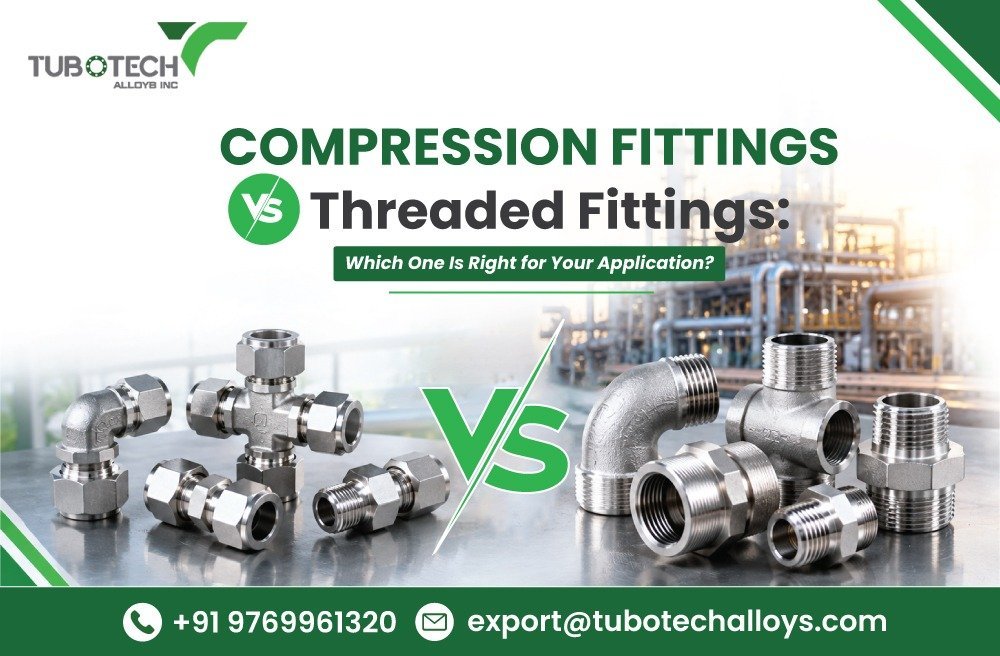
Compression Fittings Vs Threaded Fittings: Which One Is Right for Your Application?
Choosing the right fitting is essential for creating a secure, leak-resistant, and durable connection in piping and tubing systems. Two commonly used options are compression fittings and threaded fittings. While both are designed to connect pipes or tubes, they use different sealing mechanisms and are suited to different operating conditions.
So, when comparing compression fittings vs. threaded fittings, which one should you choose? The answer depends on factors such as application, pressure, temperature, tubing material, installation requirements, maintenance, and corrosion resistance.
At Tubotech Alloys Inc., we understand that selecting the right fitting can directly affect the reliability and service life of an industrial piping system. Here is a practical comparison to help you make the right decision.
What Are Compression Fittings?
Compression fittings are mechanical fittings designed to connect tubing without welding, soldering, or threading the tube itself. A typical compression fitting consists of a fitting body, compression nut, and ferrule.
When the nut is tightened, the ferrule is compressed between the nut and fitting body. This creates a tight seal around the tubing.
Compression fittings are widely used in instrumentation, hydraulic systems, pneumatic systems, process piping, gas lines, and other applications where a reliable mechanical connection is required.
What Are Threaded Fittings?
Threaded fittings connect pipes or tubes using matching male and female threads. The threads mechanically join the components, while an appropriate sealing method—such as thread sealant or PTFE tape where suitable—helps prevent leakage.
Threaded fittings are available in numerous configurations, including elbows, tees, reducers, couplings, adapters, and unions. They are commonly used in plumbing, industrial piping, hydraulic systems, and process applications.
Why Choose Compression Fittings?
The main advantage of compression fittings is their ability to create a reliable connection without requiring threading or welding of the tubing.
They can be particularly useful when:
- Tubing needs to be installed quickly.
- Welding or soldering is impractical.
- Equipment may need to be disconnected for maintenance.
- Clean and compact connections are important.
- Tubing must be connected without altering its end.
- The system uses instrumentation or small-diameter tubing.
Another important benefit is convenience. Properly installed compression fittings can be disassembled and reassembled, although repeated reuse of components—especially ferrules—should follow the fitting manufacturer’s recommendations.
Why Choose Threaded Fittings?
Threaded fittings are a proven solution for many piping applications. Their biggest advantage is versatility and availability across a wide range of pipe sizes and configurations.
Threaded connections can be appropriate where:
- Existing piping is already threaded.
- Larger pipe connections are required.
- Standard threaded components are readily available.
- The application permits threaded connections.
- Installation tools and procedures for threading are already established.
However, thread quality, correct engagement, proper sealing, and installation torque are important for achieving a dependable threaded connection.
Compression Fittings vs Threaded Fittings: Key Differences
When evaluating compression fittings vs threaded fittings, consider the following factors:
| Factor | Compression Fittings | Threaded Fittings |
| Connection method | Ferrule and compression | Male/female threads |
| Tube preparation | Generally no tube threading required | Pipe/tube must have compatible threads |
| Installation | Relatively straightforward | Requires proper thread engagement and sealing |
| Maintenance | Can be disconnected | Can be disconnected |
| Sealing | Compression of ferrule | Threads plus suitable sealing method |
| Typical use | Instrumentation, tubing, hydraulic and pneumatic systems | Piping, plumbing, industrial connections |
| Space requirements | Often compact | Can require additional space for installation |
| Leak prevention | Depends on proper ferrule installation | Depends on threads and sealing technique |
The best choice is determined by the actual application rather than by the fitting type alone.
Who Should Use Compression Fittings?
Compression fittings are particularly valuable for engineers, maintenance teams, instrumentation technicians, fabricators, and industrial installers working with tubing systems.
They are commonly found in industries such as:
- Oil and gas
- Chemical processing
- Petrochemicals
- Power generation
- Water treatment
- Pharmaceuticals
- Food processing
- Instrumentation and automation
Material selection is equally important. Stainless steel and specialized alloy compression fittings can provide improved corrosion resistance and durability in demanding environments.
When Should You Use Compression Fittings?
Compression fittings are a strong option when you need a mechanical connection for tubing and want to avoid welding or tube threading.
They are especially useful where frequent maintenance, equipment access, compact installation, or clean instrumentation connections are important.
Threaded fittings may be preferable when connecting standardized threaded piping or when the system has already been designed around threaded components.
Always consider operating pressure, temperature, media compatibility, vibration, corrosion exposure, tubing dimensions, and applicable standards before selecting a fitting.
Where Are Compression and Threaded Fittings Used?
Both fitting types have applications across industrial and commercial environments.
Compression fittings are frequently used for instrumentation tubing, hydraulic lines, pneumatic systems, process control systems, and small-diameter tubing.
Threaded fittings are commonly used in industrial piping, plumbing, hydraulic connections, compressed-air systems, and utility lines.
The fitting material should be compatible with the process fluid and environmental conditions. Stainless steel and nickel-based alloy fittings may be selected for applications involving corrosive media, elevated temperatures, or demanding service conditions.
How to Use Compression Fittings Correctly
Understanding how to use compression fittings is essential for achieving a reliable connection.
Step 1: Prepare the Tubing
Cut the tubing cleanly and squarely. Remove burrs and ensure the tube is free from dirt, oil, and damage.
Step 2: Inspect the Components
Check the fitting body, nut, and ferrule for damage. Verify that the fitting and tubing sizes are compatible.
Step 3: Insert the Tube
Insert the tubing fully into the fitting until it reaches the appropriate internal stop.
Step 4: Tighten the Nut
Tighten the compression nut according to the fitting manufacturer’s specified installation procedure. Avoid relying on excessive force as a substitute for correct installation.
Step 5: Inspect the Connection
Check that the tube remains properly positioned and that the fitting is securely assembled. After installation, pressure-test the system according to applicable procedures and safety requirements.
Correct tubing preparation and manufacturer-specified installation practices are critical. Over-tightening or improper assembly can damage components or compromise sealing performance.
Which Fitting Is Right for Your Application?
There is no universal winner in the compression fittings vs threaded fittings comparison.
Choose compression fittings when you need convenient mechanical connections for tubing, particularly in instrumentation, hydraulic, pneumatic, and process-control applications.
Choose threaded fittings when your system requires conventional threaded pipe connections or is already designed around threaded components.
For demanding industrial applications, material selection is just as important as connection design. The right combination of fitting type, alloy, dimensions, pressure rating, temperature capability, and installation method can significantly improve system reliability.
Why Choose Tubotech Alloys Inc.?
Tubotech Alloys Inc. supplies industrial fittings and alloy products designed for demanding applications. With the right technical specifications and material selection, customers can choose fitting solutions that meet their piping, tubing, instrumentation, and process requirements.
Whether your project requires stainless steel, duplex, super duplex, nickel alloys, or other corrosion-resistant materials, selecting the correct fitting begins with understanding the operating environment.
Need help choosing between compression and threaded fittings? Contact Tubotech Alloys Inc. to discuss your application, material requirements, dimensions, and service conditions.
1. What is the difference between compression fittings and threaded fittings?
Compression fittings seal tubing through a ferrule compressed by a nut, while threaded fittings connect components using mating threads and an appropriate sealing method.
2. Are compression fittings better than threaded fittings?
Not necessarily. Compression fittings can be better for many tubing and instrumentation applications, while threaded fittings can be more suitable for conventional threaded piping. Application requirements determine the best choice.
3. How do you use compression fittings?
To use compression fittings, prepare and deburr the tubing, insert it fully into the fitting, assemble the ferrule and nut correctly, and tighten according to the manufacturer’s instructions. The finished connection should then be inspected and pressure-tested as required.
4. Can compression fittings be used for high-pressure applications?
Some compression fittings are specifically engineered for high-pressure service. However, pressure capability depends on the fitting design, material, tube size, wall thickness, and manufacturer’s specifications.
5. Can compression fittings be reused?
Some compression fittings can be disconnected and reused, but reuse depends on the fitting design and manufacturer’s instructions. Ferrules may not always be suitable for repeated reuse, so components should be inspected before reassembly.
The choice between compression fittings vs threaded fittings should be based on the application’s pressure, temperature, media, tubing or pipe size, installation method, maintenance requirements, and material compatibility. Compression fittings offer convenient and reliable connections for many tubing applications, while threaded fittings remain a versatile solution for traditional piping systems.
For industrial projects where performance and material quality matter, Tubotech Alloys Inc. can help you identify suitable fitting and alloy options for your application.