




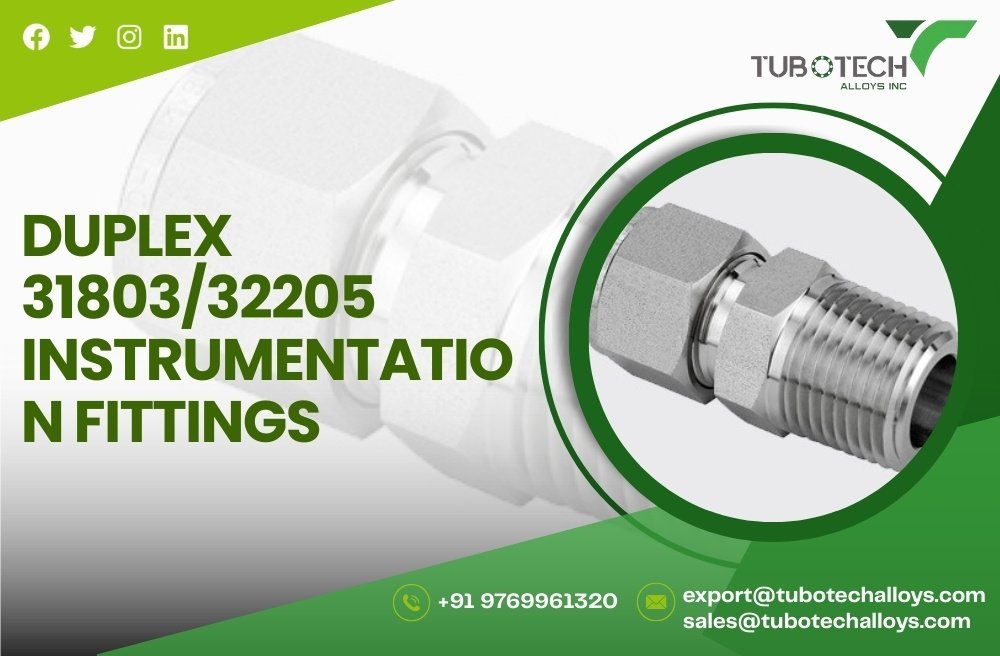
Duplex 31803/32205 Instrumentation Fittings: Strength, Corrosion Benefits and Applications
Duplex stainless steels like 32205 and 31803 Duplex, as well as 32205, are the most sought-after materials for high-end instruments where durability, as well as corrosion resistance and reliability, are important. For procurement professionals, engineers, and maintenance teams that are designing instrument tube fittings, selecting the appropriate alloy will dramatically increase service life and decrease downtime.
In this article we at Tubotech Alloys, leading Duplex 31803/32205 Instrumentation Fittings and Fittings, Duplex 31803 manufacturer in India will explain the reasons Duplex 31803 or Duplex 32205 instruments fittings are a good option, their advantages in the mechanical field their corrosion resistance, the popular applications and how to obtain these fittings from a reliable distributor or tube fittings dealer like Tubotech Alloys.
What distinguishes duplex stainless?
Duplex stainless steels blend the best characteristics of ferritic and austenitic stainless steels with a two-phase microstructure. This results in higher yield strength as well as better resistance to cracking caused by stress as compared to austenitic grades. Duplex 31803 (also called UNS S31803/S32205), as well as Duplex 32205, are popular in instrumentation due to the fact that they are able to balance durability and resistance to corrosion, while still being weldable and forming to make fittings.
The most important benefits of material include:
- High-strength duplex grades generally have more than twice the yield strength of the 300-series common austenitics, which allows lighter-weight designs and smaller wall-thickness tubing to achieve similar mechanical performance.
- Superior resistance to stress corrosion caused by chloride cracking is essential in applications that have to deal with brines, seawater, or process fluids that contain chloride.
- Excellent overall resistance to corrosion, Duplex alloys resist crevice and pitting corrosion better than other stainless steels in the right way, and are heat-treated.
- Cost-efficiency In many situations of service, duplex is an option with a lower cost of life due to lower maintenance and a longer lifespan.
Why should you choose Duplex 31803 or 32205 as instrument tube fittings?
Instrumentation systems depend on narrow-diameter tubes and precise fittings, which must ensure leak-tight connections despite pressure, temperature variations, and sometimes corrosive process conditions. Duplex 31803 and 32205 instrument fittings provide several distinct advantages:
- Safety for the mechanical. High yield strength means that fittings and tubing are able to withstand greater pressures and mechanical loads without deformation. That makes fittings made of duplex appealing in the field of chemical injection, hydraulic, as well as High-pressure sample lines.
- Reduced corrosion risk: In chloride-bearing environments–offshore, coastal plants, and desalination facilities–duplex fittings lower the risk of localized corrosion that can cause leaks or catastrophic failure.
- Reliability of hollow-components Instrumentation tubing with small diameters can be susceptible to pitting corrosion and crevices and pitting corrosion. Duplex metallurgy helps to mitigate these failure mechanisms in the event that the right grade and finish are defined.
- Compatibility Duplex fittings are offered in the same types of connectors (compression cone, weld, flare) as regular stainless fittings, making retrofits easy.
Common applications
In situations where precision, reliability, and resistance are needed, Duplex 31803/32205 instrumentation fittings are usually listed in:
- Production of oil and gas as well as processing -Hydraulic lines and controls, sample probes, and chemical injections in areas where H2S and chlorides may be present.
- Platforms offshore and FPSs exposure for long periods to aggressive atmospheres and seawater is a good option for instrumentation tubing and manifolds.
- Chemical and petrochemical facilities — where fluids could be corrosive. Small-bore fittings made of high-strength materials help reduce the risk of leaks.
- Desalination facilities and water treatment – conditions that are saline or brackish demand an improvement in pitting resistance.
- Steam and power generation plants — to power other systems that have mechanical loads and temperature fluctuations occur.
Considerations for design and installation
To maximize the use of the Duplex 31803 and 32205 instrumentation tube fittings, adhere to these top methods:
- Match metal. When possible, it is possible to make sure the fitting material matches the piping and tubing to prevent galvanic problems and to ensure that corrosion performance is consistent.
- Proper heat processing of Duplex alloys needs the careful monitoring of temperatures when they are being made and welded to ensure the integrity of the microstructure of Duplex as well as the corrosion resistance.
- Surface clean and finish System instruments benefit from smooth surface finishes as well as clear assembly procedures. However, contaminants created during installation may accelerate localized corrosion.
- Follow the pressure/temperature ratings: Utilize manufacturer information to determine allowable pressures at service temperatures. Duplex provides strengths; all components should be rated according to.
Find a reliable supplier of fittings and tube fittings retailer
Finding high-end fittings for instrumentation tubes that are available in the Duplex 311803 or 32205 requires a vendor with expertise in metallurgy, traceability, and a consistent set of manufacturing standards. Search for a fittings provider or tube fittings distributor that offers:
- Certificate of Conformity (CoC) or Mill Test Certificate (MTC) for verification of alloy.
- The traceability of heat numbers for materials or manufacturing data.
- Types of fitting types (compression flare adaptors and manifolds) in the duplex grades.
- Technical guidelines on the choice of grade (31803 instead of 32205) Surface finishes, and welding/installation guidelines.
- local stock or dependable lead times to prevent project delays.
For procurement teams looking at alternatives, Tubotech Alloys is an expert retailer and supplier who can supply tubing and instrumentation fittings that are duplex that can meet both the standard requirements and those specific to a project. Partnering with a stockist who is experienced in exotic alloys makes it easier to ensure the process of ensuring compliance with specifications and decreases supply chain risk.
In challenging chemicals, offshore or extremely high-pressure conditions, the Duplex 31803 and 32205 instrumentation fittings offer a dazzling combination of corrosion resistance and strength. Duplex grades decrease the risk of failure caused by chloride and allow lighter components, greater operating pressures, as well as extend the life of the system, making them an ideal option for oil and gas chemicals processing, desalination, and many other industries.
To derive benefit from these advantages, make sure you purchase fittings from a reliable fittings manufacturer along with tube fittings from a stockist with the appropriate certifications and technical support. Partnering with companies such as Tubotech Alloys, a top Duplex 31803/32205 and 32205 Instrumentation Fittings in India, Fittings Supplier, Duplex and Tube Fittings Stockist can aid in selecting the appropriate quality, traceability, and fit-for-service performance to meet your needs for instrumentation.